
Hiking the Fisherman’s Trail Portugal was my first solo multi-day trek, and it remains one of the most unforgettable coastal adventures I have ever done. In September 2021, I walked a large section of this incredible route along the Vicentina Coast, and the experience completely blew my mind. The golden beaches, dramatic cliffs, and ever-changing ocean views are unlike anything else in Europe.
Doing a solo hike on the Rota Vicentina is a wonderful way to be fully immersed in nature. It can confront you with your own thoughts or the feeling of being alone, but it always gives you insight into your authentic self. Whether you hike solo or with a group, walking the Fisherman’s Trail is an experience on its own — a memory to cherish.
In this detailed guide, I share my personal itinerary, practical planning tips, accommodation recommendations, and everything you need to know to hike the Fisherman’s Trail Portugal in 2022 and beyond.
Starting Point of the Trail
The Rota Vicentina, better known as the Fisherman’s Trail Portugal, stretches for 226.5 km along the southwest coast of Portugal. In September 2021, I walked a large section of it over eight days, and the experience left me with a deep appreciation for this wild, sandy coastline. Below I share my detailed itinerary, practical tips, and everything you need to plan your own hike.
What is the Fisherman’s Trail Portugal?
The Fisherman’s Trail Portugal is a 13-day coastal trek that runs from the coastal town of S. Torpes in Alentejo to the city of Lagos in Algarve. Originally the trail ended at the lighthouse town of Cabo de São Vicente, but the section to Lagos was added later. The entire route is located within the Southwest Alentejo and Vicentine Coast Natural Park, a protected environment that gives hikers access to Portugal’s most wild and remote coastal areas.
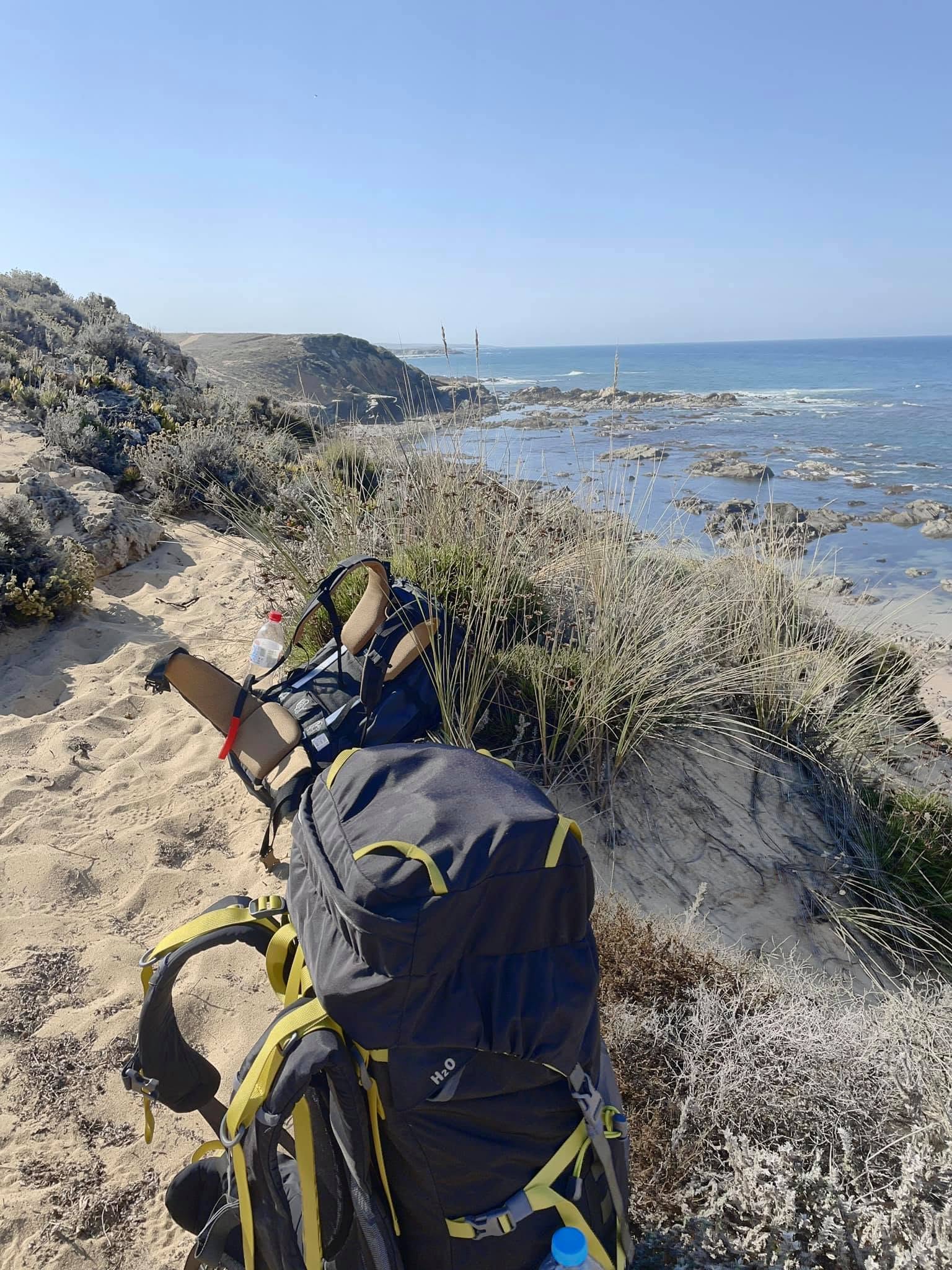
The trail follows the pathways used by locals to reach prime fishing spots. Along the way, you’ll see fishermen perched on cliffs or coastlines, calmly waiting for their catch. Aside from an occasional fishing town, there is almost no urbanization along the coast. The Vicentina Coast is by far the sandiest walk I have ever done — the terrain varies from sand dunes and wet sand to hard-packed beach walking and slightly sandy dirt trails. Although the hiking route is mostly level, the sand makes it more challenging than it looks.
Best Time to Hike the Fisherman’s Trail Portugal
The official hiking season for the Fisherman’s Trail Portugal is September to June. I recommend hiking during fall (mid-September to mid-November) or spring (mid-March to early June). Summer is far too warm, and winter brings a high probability of rain. I hiked in early September, when the number of people on the trail was decreasing but restaurants and bars were still open. I had two days of rain, but the temperature remained pleasant. To avoid the afternoon heat, leave early in the morning.
What to Pack for the Fisherman’s Trail Portugal
Packing well is essential for comfort on this sandy coastal hike. First, buy good sunscreen and wear a cap or hat — the sun in Portugal is strong all year round. A sunburned or overheated head can ruin your hike. Second, invest in a good hiking backpack and a pair of high-cut hiking boots to prevent sand from getting into your shoes. Comfort is key.
Make sure you carry at least two liters of water per day. I recommend a good quality reusable water bottle that keeps water cool, or a water bladder in your backpack. Here is my full packing list for trekking the Rota Vicentina:
- Water (at least 2 liters)
- Lunch
- Snacks, like salted nuts (you will need the salt)
- Hat or cap
- Good hiking shoes (high-cut boots recommended)
- Hiking pants
- Comfortable backpack
- Quick-dry t-shirts
- Rain jacket
- Sunglasses
- Reef-safe sunscreen
- Bikini or board shorts plus a towel (if you like to swim)
Do I Need Travel Insurance for the Fisherman’s Trail Portugal?
Travel insurance is not mandatory, but I highly recommend it. If you get seriously sick or injured on the trail, paying medical expenses yourself is something you want to avoid. Insurance also covers lost baggage, theft from accommodation, and flight cancellations or delays. My preferred choice is World Nomads, which promotes responsible tourism. When you buy a policy with World Nomads, you can add a small donation to fund community development projects — 100% of your donation goes directly to the project of your choice. World Nomads also lets you extend your coverage while traveling if you decide to stay longer.
Where to Book Accommodation on the Fisherman’s Trail Portugal
Hostels, hotels, and guesthouses can be found in every town along the Rota Vicentina. I skipped campsites, even though there are some in Porto Covo, Vila Nova de Milfontes, Zambujeira do Mar, Odeceixe, Aljezur, and Sagres. For hostels, I recommend Hostel World. For hotels or apartments, Booking.com is my preferred platform. If you plan to stay longer before or after your hike, Airbnb is a good option.
I booked my accommodation one or two days in advance. In early September it was somewhat busy, but knowing what I know now, planning two days ahead is a good rule. In June and August, book well in advance and contact campsites to check availability. Prices vary by season and seem to be increasing, so it’s worth comparing options. A few tips: check-in time is often around 3 pm, make sure your accommodation is in the town itself to avoid extra walking, and check whether you need to pay before arrival or on arrival.
Luggage Transfer on the Fisherman’s Trail Portugal
If you prefer not to carry a heavy backpack, you can arrange a luggage transfer from accommodation to accommodation. Vicentina Transfers is the main company providing this service on the Fisherman’s Trail. It costs €15 per piece of luggage per section. Make sure you have booked your accommodation in advance so the company knows where to deliver your bags.
How to Get to the Fisherman’s Trail Portugal
There are direct buses from Lisbon to Porto Covo, Lagos, or anywhere in between. Rede Expressos buses leave throughout the day from Sete Rios bus station in Lisbon. The journey from Lisbon to Porto Covo takes about 2 hours and costs around €20 for a single transfer. Tickets can be bought at the terminal or online — I recommend purchasing in advance. For the return trip, direct buses to Lisbon are available from almost every town except Arrifana and Salema.
If you arrive at Faro airport, public transport is poor. A private transfer is the easiest and fastest way to reach Lagos. You can book one in advance via GetYourGuide. Costs are around €83 for a single transfer, taking approximately 70 minutes along the A22 expressway. If you’re flying in, I recommend using Aviasales for comparing flight prices to Lisbon or Faro, and AutoEurope for renting a car if you plan to explore more of the coast before or after your hike.
Practical Information for Hiking the Fisherman’s Trail Portugal
- Tap water in Portugal is fine to drink. You don’t need to buy bottled water or use filters, though some regions may taste slightly of chlorine.
- The hiking route is well indicated with blue and green markers. No guide or tour is necessary.
- The trail can get very hot in summer, so start walking early in the morning.
- Every town on the trail has ATMs, shops, and accommodation. You don’t need to carry lots of cash or food, but do bring snacks and water because distances between towns are long and there are no taps to refill bottles.
- There is a Cicerone guidebook on the Rota Vicentina that provides a lot of useful information.
- July and August are peak tourist season, which increases accommodation prices significantly.
My Fisherman’s Trail Portugal Hiking Itinerary
The official Fisherman’s Trail starts or stops at Lagos and S. Torpes, with each stage between 16 and 22 km. Most hikers start in the north because of wind directions, but I decided to hike from south to north for practicality. I had the sun on my back, which made the views even better. My total distance was 124 km over 8 days, with an average cost of €30 per person per day. I stayed in hostels and one studio. Here is my day-by-day breakdown:
- Arrival Day: Lagos
- Day 1: Vila do Bispo to Carrapateira (16 km, 7h)
- Day 2: Carrapateira to Aljezur (21.5 km, 6h 30 — skipped Arrifana, went inland)
- Day 3: Resting day in Aljezur
- Day 4: Aljezur to Odeceixe (22.5 km, 7h)
- Day 5: Odeceixe to Zambujeira do Mar (18.5 km, 5.5h)
- Day 6: Zambujeira do Mar to Almograve (skipped via Rede Expressos), then Almograve to Vila Nova de Milfontes (15.5 km, 5.5h)
- Day 7: Vila Nova de Milfontes to Porto Covo (20 km, 6.5h)
- Day 8: Porto Covo to São Torpes (10 km, 3.5h)
Note to self and others: Do not hike with 20 kilos in your backpack (like I did). It makes life a bit easier.
Day 1: Vila do Bispo to Carrapateira (16 km, 7 hours)
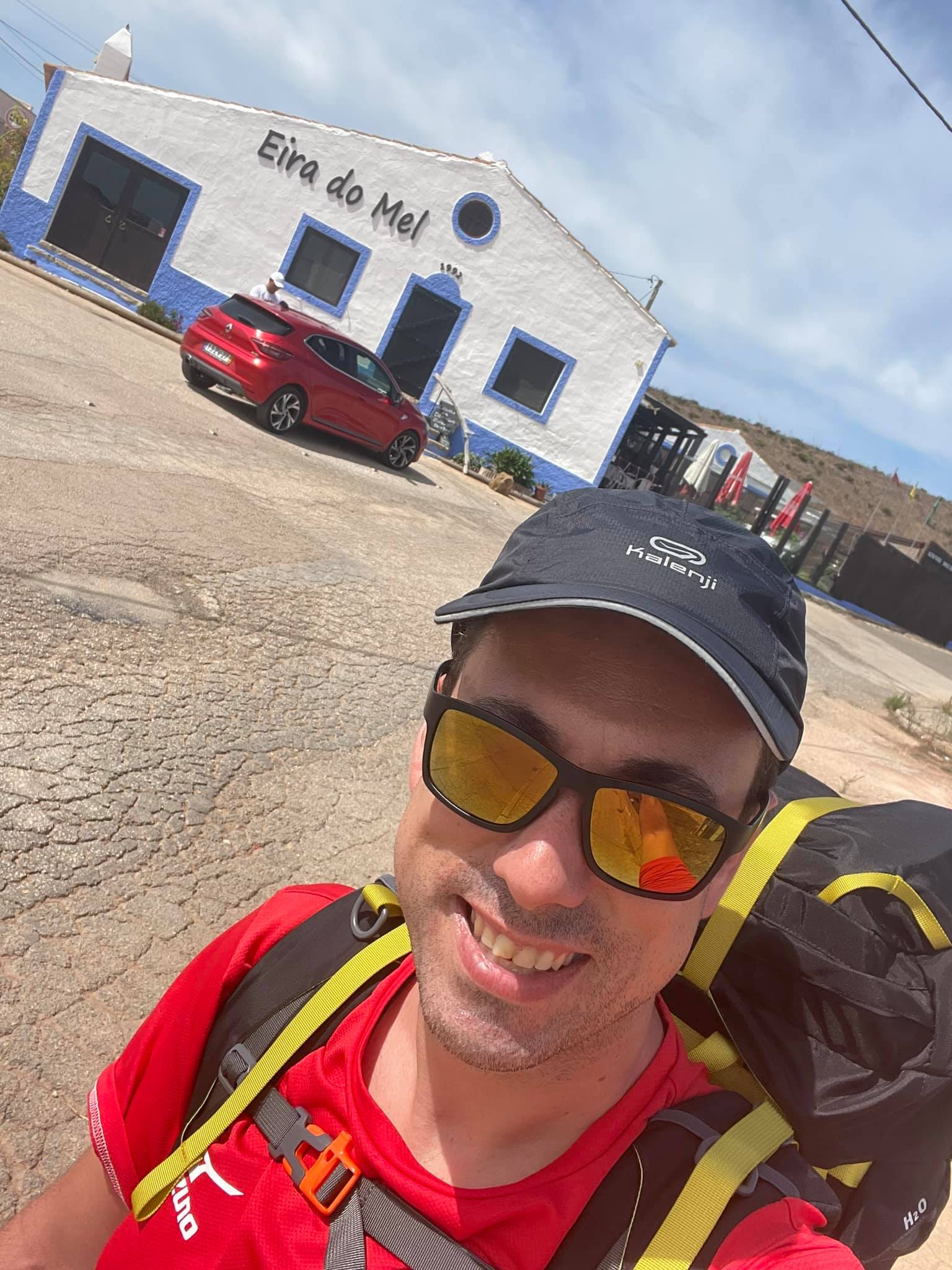
This first stage on the Fisherman’s Trail (Trilho dos Pescadores in Portuguese) offers unquestionably the most amazing scenes. When you think you’ve seen everything, you’ll be dazed by the incredible cliffs and coastliness: Amado, Murração, and Manteiga are three genuine pearls of nature. I started the hike at a restaurant called Eira do Mel. I wasn’t sure where the official starting point was, but with the Rota Vicentina app and Google Maps I found my way. The route initially follows the N268, then a dirt road next to it. The green and blue markings appear shortly after, and the Fisherman’s Trail hike begins.
After a while, I reached Praia da Pena Furada, where the path becomes super narrow and makes a big drop. The beach is stunning and enclosed by rock formations. Continuing north, I passed Praia da Murração, a popular spot for van lifers, and then overlooked Praia do Amado with its beautiful red cliffs. If you want a detour, you can visit the remains of the Islamic settlement of Ponta do Castelo from the twelfth and thirteenth centuries. After a couple more hours, Carrapateira came into view.
Where to Eat: Ribeira do Poço, Sítio do Forno, CATO Restaurant.
Accommodation: Hostel do Mar — very pleasant, clean bathroom, amazing terrace for sunset, and great for surfers.
Day 2: Carrapateira to Aljezur (21.5 km, 6 hours 30 minutes)
On the second day, I couldn’t find a hostel in Arrifana the day before, so I decided to walk directly to Aljezur. Instead of the coastal route (which would have been about 31 km), I went inland via Google Maps. It wasn’t the most beautiful route — much of it was outside the Rota Vicentina path with a lot of urbanization — but my mind wandered and time passed quickly. Aljezur came into sight before I knew it.
Where to Eat: Alecrim, Taberna do Largo.
Accommodation: Amazing Hostel — the pictures create high expectations, but for one or two nights it’s fine. Bring a sleeping mask and earplugs.
Day 3: Resting Day in Aljezur
Day 3 was a resting day. It started to rain heavily, so I stayed one more night at the hostel. Aljezur is a little coastal town in Algarve, part of the Rota Vicentina route. It sits near a small river and is surrounded by green hills. An arch bridge divides the town into old and new parts. You’ll see typical white houses on the hills, and on top of one of the biggest hills there is a castle ruin. Beaches are close by and great for surfing. You need a car or mountain bike to explore the surrounding area. This town is growing in popularity, with yoga retreats, spiritual communities, and surfing schools appearing. It’s a great place to rest on the Fisherman’s Trail.
Day 4: Aljezur to Odeceixe (22.5 km, 7 hours)
A new day, a new adventure! I continued north on the Rota Vicentina to Odeceixe, another small town not directly by the sea. The beach is 3 km away. In Odeceixe, the Fisherman’s Trail and the Historical Way join. If you want accommodation near the beach, you can walk an extra 3.5 km to Praia de Odeceixe, a tiny place with a couple of hotels and restaurants right at the beach. It’s visible from the cliff on the way. Note: Do not cross the river in direction to Zambujeira as the town is on the same side.
Where to Eat: ALTINHO – TAPAS & PETISCOS – BISTRÔ, PÃO DO ROGIL, RESTAURANTE DA PRAIA.
Accommodation: Horta do vale Nature House — very pleasant, the owner made it feel like home. Odeceixe is a charming place.
Odeceixe Tips: Celebrate the end of the trek with a bottle of wine and tapas at Altinho (excellent food, albeit a bit overpriced). Walk up to the windmill “Moinho de Odeceixe” for sunset views.
Day 5: Odeceixe to Zambujeira do Mar (18.5 km, 5.5 hours)
Leaving Odeceixe, I crossed the river and moved from the Algarve region to the Alentejo. After the first 6 km, I passed the small city of Praia de Odeceixe on the other side of the river. With low tides it’s possible to cross the river, with water reaching knee deep. From this point, the route goes right next to the ocean, offering amazing views. This stage had some up and down hills, but compared to my previous stage it felt like a breeze.
Where to Eat: O SACAS, A BARCA TRANQUITANAS, I CERVEJARIA, CASINO DA URSA, RESTAURANTE COSTA ALENTEJANA.
Accommodation: Hakuna Matata Hostel — super central, just steps from the beach. I had a room with one bunk bed, very spacious and clean. The owner was super friendly, and the shared facilities looked like everything I could need.
Day 6: Zambujeira do Mar to Almograve (skipped), then Almograve to Vila Nova de Milfontes (15.5 km, 5.5 hours)
I had to skip the section between Zambujeira do Mar and Almograve because I couldn’t find affordable accommodation in Zambujeira even though peak season was almost over. So I booked a Rede Expressos bus ticket one day in advance and traveled to Almograve, where I started my next hiking adventure. From Almograve I took the more scenic way along the coast, passing beautiful beaches. I took my hiking shoes off while walking on the beach itself — it felt much more comfortable feeling the sand between my toes.
With Vila Nova de Milfontes in sight, you can stop at Praia das Furnas. The beach itself is outside the Fisherman’s Trail, but I recommend going down and walking on the beach. Note: When you are 4 km away from Vila Nova de Milfontes, you pass by the Ocean Drive Beach restaurant. For around €5 per person you can take a ferry to Vila Nova de Milfontes from here. You won’t miss a lot because from there most of the route is paved road, and I’d rather spend my time on the beach.
Where to Eat: Casa do Benfica, TASCA DO CELSO, PORTO DAS BARCAS, GELADARIA DA PIETRO, HS GRILL & BUFFET RESTAURANT, RESTAURANTE STRESS FREE.
Accommodation: Selina — despite some bad reviews, I found it comfortable and very clean. The location is near the river Mira and on the route of the Fisherman’s Trail. If you need a co-working space, I recommend Cantinho do Mercado instead.
Day 7: Vila Nova de Milfontes to Porto Covo (20 km, 6.5 hours)
Between Vila Nova de Milfontes and Porto Covo, the Fisherman’s Trail has some amazing views along the shore and beach. Beautiful cliffs can be seen here. A few beaches worth mentioning are Praia da Ilha do Pessegueiro, Praia dos Aivados, Praia do Saltinho, Praia dos Nascedios, and Praia do Malhão. It’s possible to walk barefoot on the beaches instead of the coastal route. If you walk north, the last 10 km can be done on the beach. The entire walk was one big spectacle of nature. Make sure you have enough water!
Where to Eat: ARTE E SAL, LA BELLA VITA, RESTAURANTE A ILHA, PORTO DAS BARCAS, TASCA DO CELSO, GELADARIA DA PIETRO, HS GRILL & BUFFET, RESTAURANTE STRESS FREE.
Accommodation: Apartment in Porto Covo — on this last trail I was joined by a friend who lives in Lagos. We booked a studio via Booking.com. It was time for a comfortable room.
Day 8: Porto Covo to São Torpes (10 km, 3.5 hours)
Last day and final destination: São Torpes! Here is where my hike on the Fisherman’s Trail ended, and for many hikers it’s where the journey begins. For those who start from São Torpes, which is near the city of Sines, there is no public transport. Sines has a good public transport connection — you can arrive or leave with a Rede Expresso bus to and from Lisbon and Lagos. From Sines you can take a taxi, which is a 10 to 15 minute drive to São Torpes.
Where to Eat: O TARRO, FONTE FÉRREA.
Best Guidebooks for the Fisherman’s Trail Portugal
- Lonely Planet Portugal Travel Guide
- Cicerone’s Rota Vicentina Hiking Guide
- Walking in Portugal: 40 graded short and multi-day walks throughout the country, 2018 (Paperback & Kindle)
On the Trail
The Fisherman’s Trail Portugal is more than a hike — it’s a journey through some of Europe’s most raw and beautiful coastline. Every sandy step is worth it.
Some links in this article are affiliate links. If you buy through them I may earn a small commission, at no extra cost to you. I only recommend tools and platforms I have personally used or would use myself.